
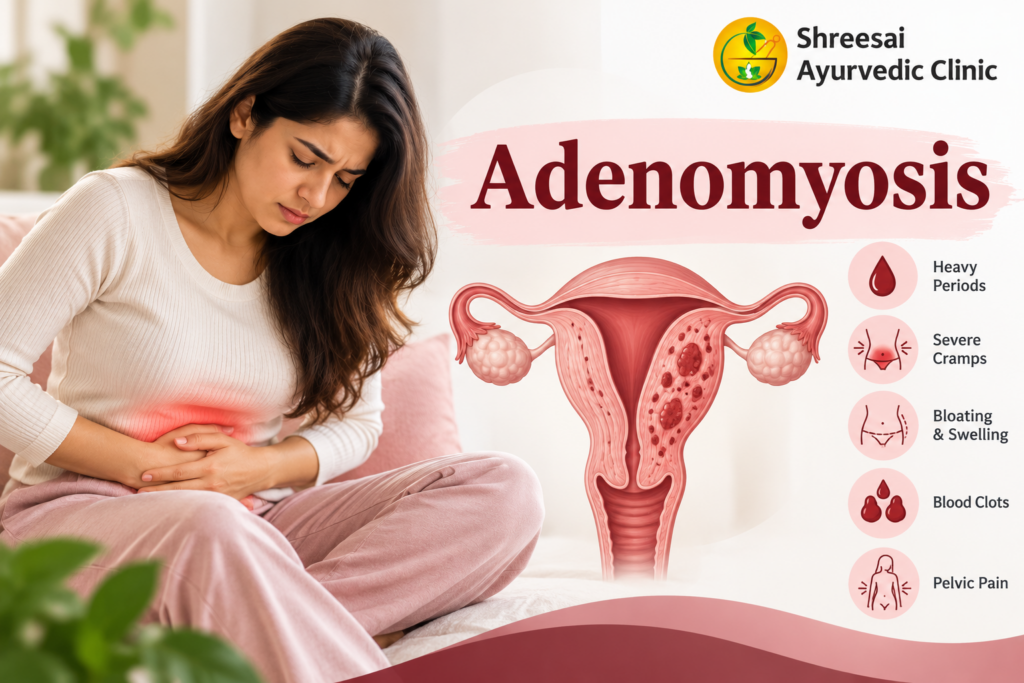
Adenomyosis: Causes, Symptoms, Home Remedies & Ayurvedic Management
Modern Anatomy
To picture adenomyosis, imagine your womb (uterus) as a room where the walls are made of thick, sturdy brick (muscle tissue), and the room is lined with plush, soft velvet wallpaper (the endometrium). Every month, this wallpaper naturally thickens to prepare for a baby, and if no pregnancy occurs, it sheds as your period.
The Problem
In adenomyosis, cells from that soft wallpaper burrow deep inside the heavy brick walls themselves, growing inside the uterine muscle.
The Result
When your period comes, that trapped wallpaper inside the muscle wall also bleeds. But because that blood has nowhere to escape, it pools inside the muscle. This causes the uterus to become intensely swollen, bruised, severely inflamed, and double or triple its normal size.
Causes & Symptoms
Root Causes
Estrogen dominance (too much estrogen compared to progesterone), local inflammation of the uterine wall, past uterine trauma (like a C-section, D&C, or fibroid surgery), or genetic tendencies.
Key Symptoms
Prolonged bleeding(menorrhagia),knife-like period cramps (dysmenorrhea) that can start days before the bleeding; a heavy, hard, bloated lower abdomen; passing very large blood clots; and deep pelvic pain during intimate relations.
Correlation with Ayurveda
In Ayurveda, adenomyosis is understood as a complex mixture of Rakta Pradara (excessive bleeding) and Yoni Vyapad (uterine disorders) driven by Udaavarta (the upward/reverse movement of Vata).
Dosha & Tissue Involvement
It heavily involves Vata and Pitta doshas affecting the Mamsa (muscle) and Rakta (blood) tissues. Apana Vata (the sub-type of Vata responsible for downward flow during periods) gets blocked and begins moving upward or erratically. This erratic movement forces endometrial tissue into the muscular layers of the womb. Concurrently, highly aggravated Pitta causes intense heat, burning, localized tissue swelling, and heavy bleeding within the uterine muscles.
Home Remedies
External Castor Oil Pack
Soak a piece of flannel or cotton cloth in pure, unrefined, hexaneless castor oil until saturated.
How to use: Place it over your lower abdomen, cover it with a plastic sheet, and place a warm heating pad or hot water bottle over it for 30–45 minutes. Do this 3-4 times a week,
Castor oil contains ricinoleic acid, which penetrates deeply to reduce internal muscle swelling, break down abnormal tissue, and soothe pain.
CCF + Turmeric Anti-Inflammatory Tea
Recipe: Boil ½ teaspoon each of Cumin, Coriander, and Fennel seeds with a fresh ½ inch slice of ginger and ¼ teaspoon of organic turmeric powder in 2 cups of water until it reduces to 1 cup.
How to use: Drink this warm twice a day. This blend flushes pelvic heat, acts as a natural anti-inflammatory, and regulates the erratic movement of Vata.
Ahar & Vihar (Diet & Lifestyle)
Ahar (What to Eat vs. What to Avoid)
Strictly Avoid:
Red meat, aged cheese, white sugar, highly sour foods (vinegar, tamarind, lemons in excess), fermented foods (idli, dosa, curd), pickles, and hot chilies. These foods directly inflame the blood (Rakta) and worsen uterine swelling.
Actively Include:
Cooling, grounding, and sweet-nourishing foods. Eat plenty of bottle gourd (lauki), ridge gourd (torai), ash gourd juices, boiled pumpkin, ripe bananas, soaked figs, and split yellow mung dal cooked with a generous amount of cow’s ghee. Ghee is deeply therapeutic here as it cools Pitta and softens Vata’s hardness.
Vihar (Daily Routine & Exercise)
Complete Rest During Periods:
During your menstrual cycle, strictly avoid any physical exertion, running, heavy lifting, or long commutes. Your body requires complete rest to allow Apana Vata to flow downward naturally without resistance.
Gentle Movement:
Outside of your period, avoid intense, high-impact gym workouts. Instead, practice ultra-gentle, restorative yoga postures like Supta Badha Konasana (Reclining Bound Angle) supported by pillows, Balasana (Child’s Pose), and deep, slow abdominal breathing (Anulom Vilom Pranayama) to calm your nervous system.
Ayurvedic Kalpa
Dashmoola Rishta / Kashaya
as a supreme anti-inflammatory and muscle relaxant, specifically targeted at easing severe uterine cramps.
Kanchanar Guggulu & Sphatika Bhasma
Used together to arrest abnormal tissue expansion within the muscle and dry up internal bleeding sites.
Ashokarishta / Pradrantak Churna
herbs like Ashoka and Lodhra constrict the blood vessels and tone the uterus.
Panchakarma (Deep Purification)
Anuvasana & Matra Basti (Oil Enemas)
Infusing the lower colon with warm, medicated oils like Sahacharadi Taila or Dhanwantaram Taila. Since the colon sits right behind the uterus, these oils absorb directly into the pelvic tissue, calming the erratic Vata and softening the hard, swollen uterine walls.
Uttara Basti (Intrauterine Therapy)
The gold standard for adenomyosis. After thorough external purification, an Ayurvedic specialist introduces a tiny, sterile amount of medicated ghee (like Phala Ghrita or Kshirabala Taila) directly into the womb through the cervix. This directly coats, cools, and heals the inflamed inner muscular layers.